learn
/
methodology
The Marketing Engineer: The Role Every Growth Team Will Need
A marketing engineer is a marketer who builds: they connect data, automate decisions, build AI agents and measure incrementality. Skills, role and hiring.

Get one practical marketing measurement idea every week
A marketing engineer is a marketer who builds. They connect marketing data, automate recurring decisions, design workflows and AI agents, and measure what each channel really adds with incrementality tests and marketing mix models. The result is a small team that runs growth work which used to need several specialists.
Key takeaways
The marketing engineer is part marketer, part builder. They own the system that makes marketing decisions, not only the campaigns.
Four jobs define the role: connecting data, automating decisions, building workflows and agents, and measuring incrementality.
It differs from marketing ops, which runs the stack, and from a data analyst, who explains what happened.
The best candidates often come from performance marketing or analytics and have taught themselves to build.
With a marketing brain and agents doing the repetitive work, one marketing engineer can cover what used to take a team.
Why the role is appearing now
Three changes have arrived at the same time.
First, measurement has moved away from user-level tracking. Privacy rules and browser changes mean many teams can no longer follow every click to a sale. Causal methods such as marketing mix modeling and holdout tests have filled the gap, and they need someone who understands both the statistics and the business.
Second, AI agents can now do real work: read reports, draft budget changes, prepare ads, run tests. Someone has to decide what they are allowed to do, connect them to data and check their output.
Third, growth teams have hit a ceiling. Adding people adds handovers, and learnings get lost between briefs, agencies and reports. Companies want fewer, more capable people supported by systems that remember.
The marketing engineer is the person who sits where those three changes meet.
What a marketing engineer does
Connects data
They bring spend from every ad platform and sales from every store or CRM into one clean dataset, by campaign and by day. They map campaigns, currencies and conversion windows so numbers agree. They decide which sources a system may read and which it may change.
Automates decisions
Many marketing decisions repeat every week: shift budget toward the channel with room to grow, pause ads that stopped adding sales, refresh tired creative. A marketing engineer turns these into rules or agent workflows with clear limits, so the routine moves happen on time and the big ones go to a person.
Builds workflows and agents
They write the instructions, choose the tools and set the permissions for AI agents. A typical example: every Monday, check stock levels and pause ads for products that are about to sell out, then restart them when stock is back. They test these workflows on real data before turning them on.
Measures incrementality
They know the difference between what a platform reports and what an ad caused. They design geo tests and holdouts, read the results and use them to calibrate the marketing mix model. Open source tools such as Meta's GeoLift and Google's Meridian are part of the common toolkit.
Skills a marketing engineer needs
Performance marketing: how ad platforms bid, budget and report, and what moves results in practice.
Measurement: marketing mix modeling, incrementality testing, diminishing returns and the limits of attribution.
Data: SQL, spreadsheets that scale, data pipelines and the habit of checking that totals match.
Automation and AI: APIs, workflow tools and how to instruct, limit and evaluate AI agents.
Experiment design: control groups, test duration, power and how to say "the test was inconclusive".
Communication: explaining a budget move to a CFO in two sentences, with the evidence attached.
Nobody starts with all six. Most marketing engineers are strong in two or three and competent in the rest.
A typical week
The work changes by company, but a week often looks like this:
Monday: review the growth plan the system proposed, approve the budget moves that fit the evidence, reject or question the ones that do not.
Tuesday: design a geo test for a channel nobody is sure about, and agree the regions and the duration with the team.
Wednesday: build a new workflow requested by the creative lead, then test it on last month's data.
Thursday: check last week's changes against what was expected and update the team on what was learned.
Friday: fix a broken data source, tighten a rule that let through a move it should have held, and plan next week.
Notice what is missing: building reports by hand and copying numbers between platforms. The point of the role is to remove that work.
Marketing engineer vs similar roles
Marketing ops vs marketing engineer
Marketing operations keeps the stack running: tools, integrations, lead routing, campaign setup and process. A marketing engineer builds on that stack to make and execute decisions, and owns whether those decisions caused growth. Ops asks "is the system working?" The marketing engineer asks "is the system making the right calls?"
Growth marketer
A growth marketer runs campaigns and experiments across channels. A marketing engineer does some of this, but spends more time building the systems that run campaigns and measure them, so the work scales beyond one person's hours.
Growth engineer
A growth engineer is usually a software engineer who builds product features to improve sign-up, activation or retention. The marketing engineer works mostly outside the product, on paid media, budgets, measurement and marketing automation.
Data analyst
A data analyst explains what happened. A marketing engineer uses that understanding to change what happens next, and builds the loop that checks the result.
How to hire a marketing engineer
The title is new, so few people have held it. Look for the pattern instead:
Performance marketers who taught themselves SQL or Python because the reports were not good enough.
Analysts who got tired of presenting findings that nobody acted on and started automating the actions.
People who can describe a test they ran, what it showed and what they changed because of it.
In interviews, give a real problem: two channels, conflicting platform numbers, one budget decision. Ask how they would find out what is true, and what they would automate once they knew. Listen for causal thinking and for limits: what the system should never do without a person.
How to become a marketing engineer
Learn causal measurement. Start with the difference between attribution and incrementality, then learn how a marketing mix model and a geo test work.
Get close to the data. Pull spend and sales from the source, join them by day, and check that the totals match.
Automate one decision. Pick a weekly choice your team makes by hand and turn it into a rule with a clear limit.
Work with agents. Learn how to give an AI agent tools, context and limits. Anthropic's guide to building effective agents is a good starting point.
Close the loop. For every change you automate, decide in advance how and when you will check whether it worked.
How one person can do the work of a team
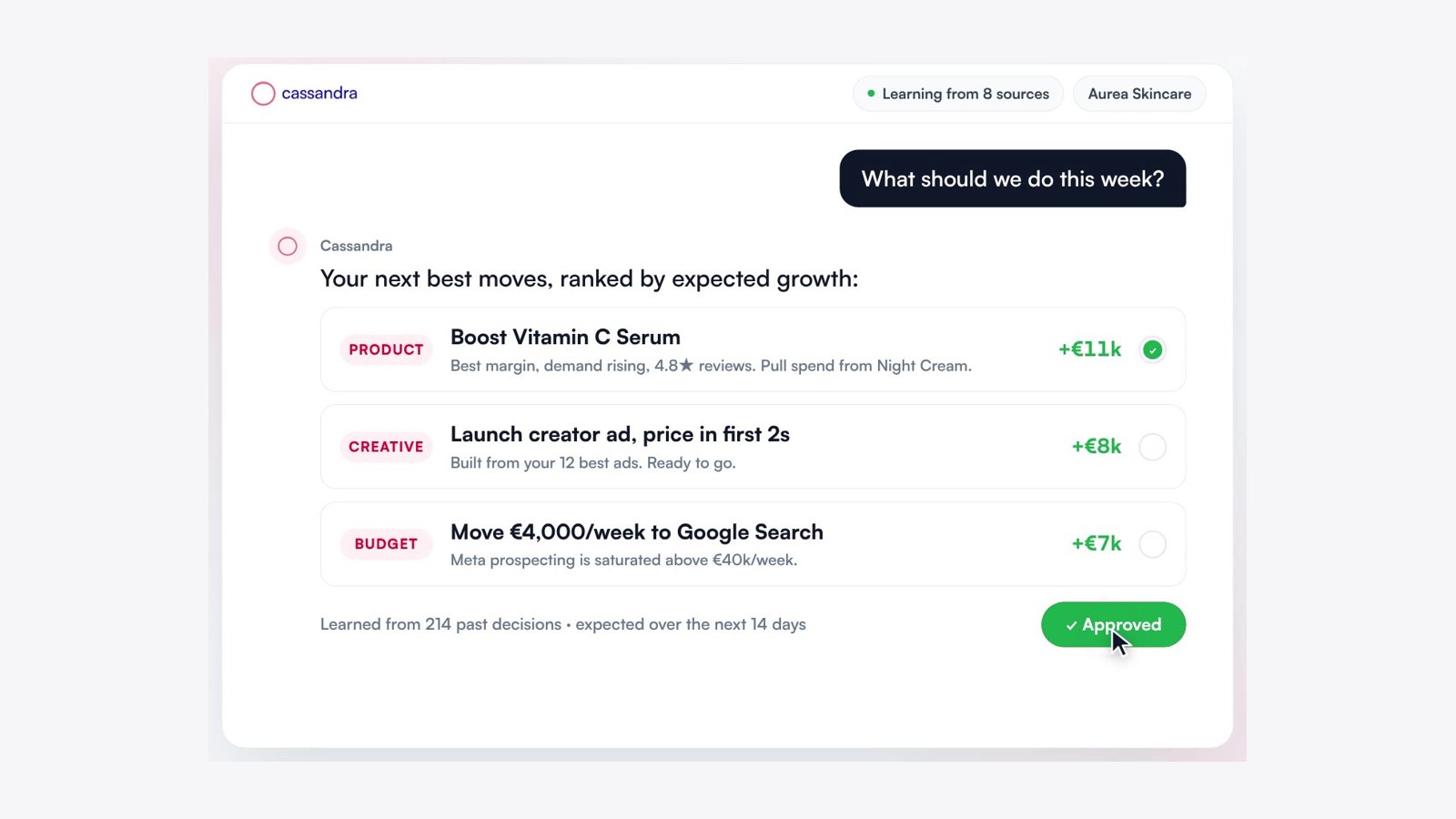
A marketing engineer does not need to build everything from scratch. A marketing brain such as Cassandra provides the layers: a data pipeline that keeps every source current, a synthetic brain that keeps context, causal models, test results and every decision, a harness of specialist agents for strategy, media buying, creative and analysis, and tools that change budgets, ads and experiments in production within the rules you set.
Preset skills cover incrementality testing, marketing mix modeling, always-on measurement, budget allocation and creative analysis. When the team needs something new, the marketing engineer describes the workflow in plain words and Cassandra builds it on the same layers. The engineer's time goes into judgement: which moves to approve, which tests to run, which rules to tighten.
Not every company has a marketing engineer yet. Cassandra offers a managed option on its pricing page: a Cassandra marketing engineer sets up and runs it with your team.
FAQ
What does a marketing engineer do?
A marketing engineer connects marketing data, automates recurring decisions, builds workflows and AI agents, and measures what each channel really adds. They own the system that decides and executes, not only individual campaigns.
What is marketing engineering?
Marketing engineering is the practice of building systems that make, execute and check marketing decisions: data pipelines, causal measurement, automation and agents with clear limits.
Is a marketing engineer the same as a growth engineer?
Not usually. A growth engineer tends to be a software engineer working on the product funnel. A marketing engineer works on paid media, budgets, measurement and automation.
Do marketing engineers need to code?
Some code helps, especially SQL. But the role is defined by building systems and thinking causally, and modern tools let much of the building happen in plain language.
Can a small company have a marketing engineer?
Yes. Small teams often gain the most, because one person with the right systems can cover measurement, budgeting and automation that would otherwise need several hires or an agency.
Cassandra is a marketing brain built for marketing engineers. It learns what works, decides what drives growth and executes it for you, within your rules. Run it yourself, or have a Cassandra marketing engineer run it with your team. Start for free.