learn
/
methodology
Build your marketing messaging from customer words, with Claude Code
Install a free demand map skill in Claude Code, map what customers want and fear in their own words, and turn it into a tested messaging strategy.
By Gabriele Franco, co-founder of Cassandra


Get one practical idea every week to grow with the same team
To build your messaging from what customers actually say, install the free demand-map skill in Claude Code and run /demand-map with your website URL. In 5 to 15 minutes it reads your site, reviews and forums, and gives you a messaging strategy where every claim links to its source.
If you ask an AI to "write our messaging", it starts from what you tell it about your audience, and you get your own opinion back in nicer words. We wanted the opposite: start from what buyers actually write in reviews and forums, then build the messaging on top. So we turned that process into a Claude Code skill called demand map. It's free, you install it with one file, and a run takes 5 to 15 minutes.
Below is how to set it up, and what came out when we ran it on our own site.
What do you need?
Claude Code, with a Pro, Max, Team, Enterprise or Console account. The free Claude plan doesn't include it.
Your website URL.
Optional: your ad data connected (Meta Ads, Google Ads, GA4), so Claude can also check which messages your current ads already use.
What does the demand map give you?
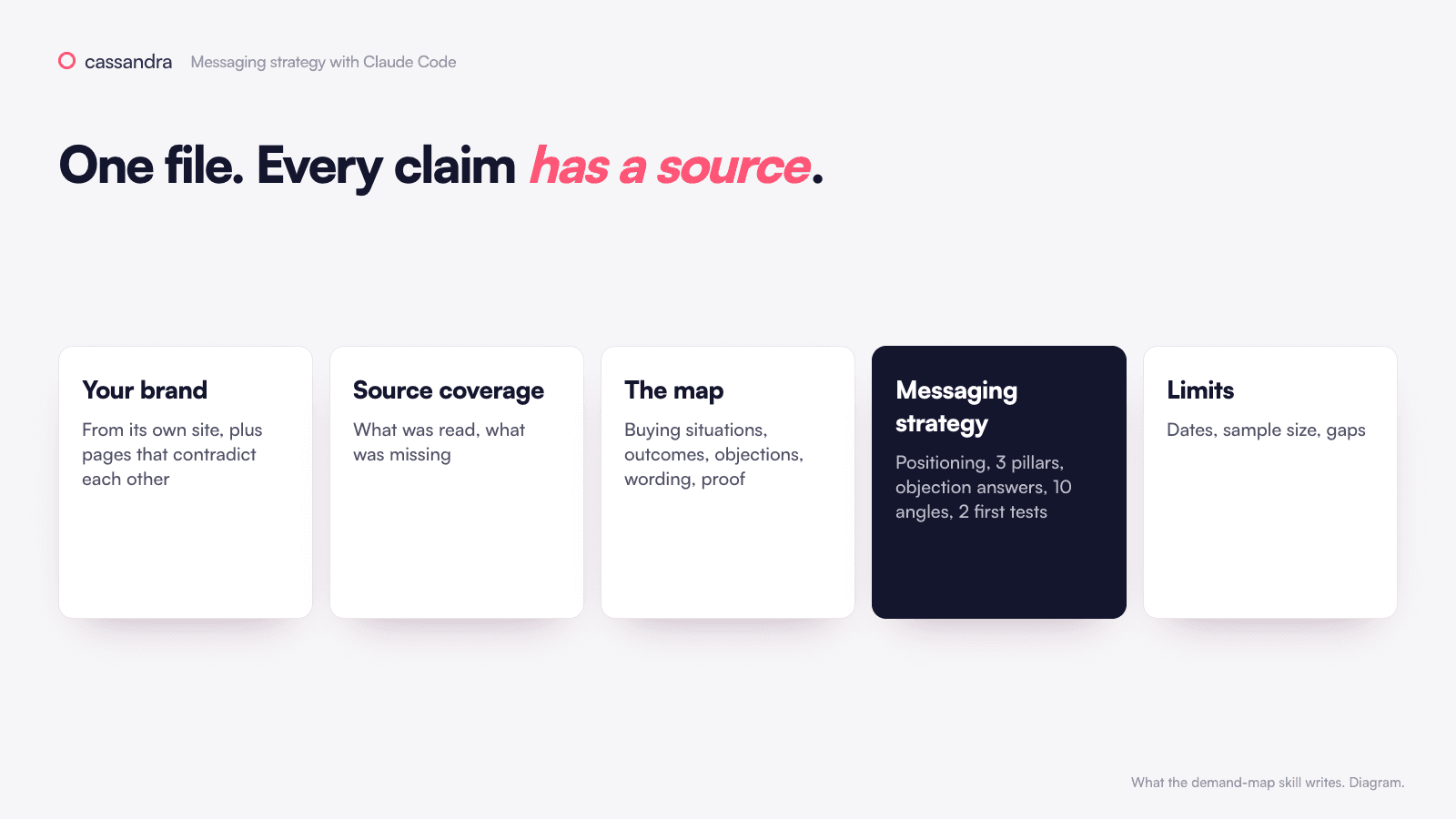
A Markdown file with five parts:
Your brand as described on its own site, plus any pages that contradict each other.
Which review sites and forums it read, and which ones it couldn't.
The map itself: when people start looking, what they want, what stops them, the words they use, the proof they need, and the experiences that go against your promises. Every item has a quote and a link.
A messaging strategy: a positioning line, three message pillars, answers to the main objections, ten ad angles and the two worth testing first.
The limits: dates, how many sources, what's missing.
How to install and run the demand-map skill, step by step
1. Install Claude Code
Open a terminal and paste:
On Windows PowerShell, use irm https://claude.ai/install.ps1 | iex. Then open a new terminal and run claude --version to check it's there.
2. Make a folder for the skill
Claude Code looks for your own skills in ~/.claude/skills/. Paste:
3. Save the skill file
Copy the skill text at the bottom of this page and save it as ~/.claude/skills/demand-map/SKILL.md. The folder and the name: line in the file both need to say demand-map. If you'd rather not touch files, open Claude Code and ask it to "create ~/.claude/skills/demand-map/SKILL.md with this text", then paste it.
4. Start Claude Code in a new folder
The first time, it opens your browser so you can sign in.
5. Run it
Type this with your own URL:
Claude asks before it searches the web or opens a page. Let it do that for this session. Depending on how much is written about your brand, it takes 5 to 15 minutes.
6. Read the file
Claude saves demand-map-<brand>-<date>.md in the folder and gives you the positioning line, the three pillars and the two first tests in the chat. Open the file and click three or four source links at random. The quote should be on the page it links to.
How do you check the map is built on real sources?
Ask a follow-up that only works if the map is built on real sources:
You should get one objection, how many sources mention it, a short quote and a link. If there's no link, the map isn't grounded. Ask Claude to "mark every item without an original source as a hypothesis".
What did the demand map find for cassandra.app?
We ran it on our own site on 22 October 2026: /demand-map https://cassandra.app.
The first thing it found was that there's almost nothing public about Cassandra to read. The review sites that list us block automated reading, and Reddit blocked the research tool. The skill said so in its coverage table and built the map from the whole category instead: 29 public sources, from reviews of attribution and AI ad tools to GitHub issues of open-source marketing mix models, Hacker News threads and a practitioner's blog. It kept 35 excerpts and threw out two near-identical 5-star reviews that looked planted.
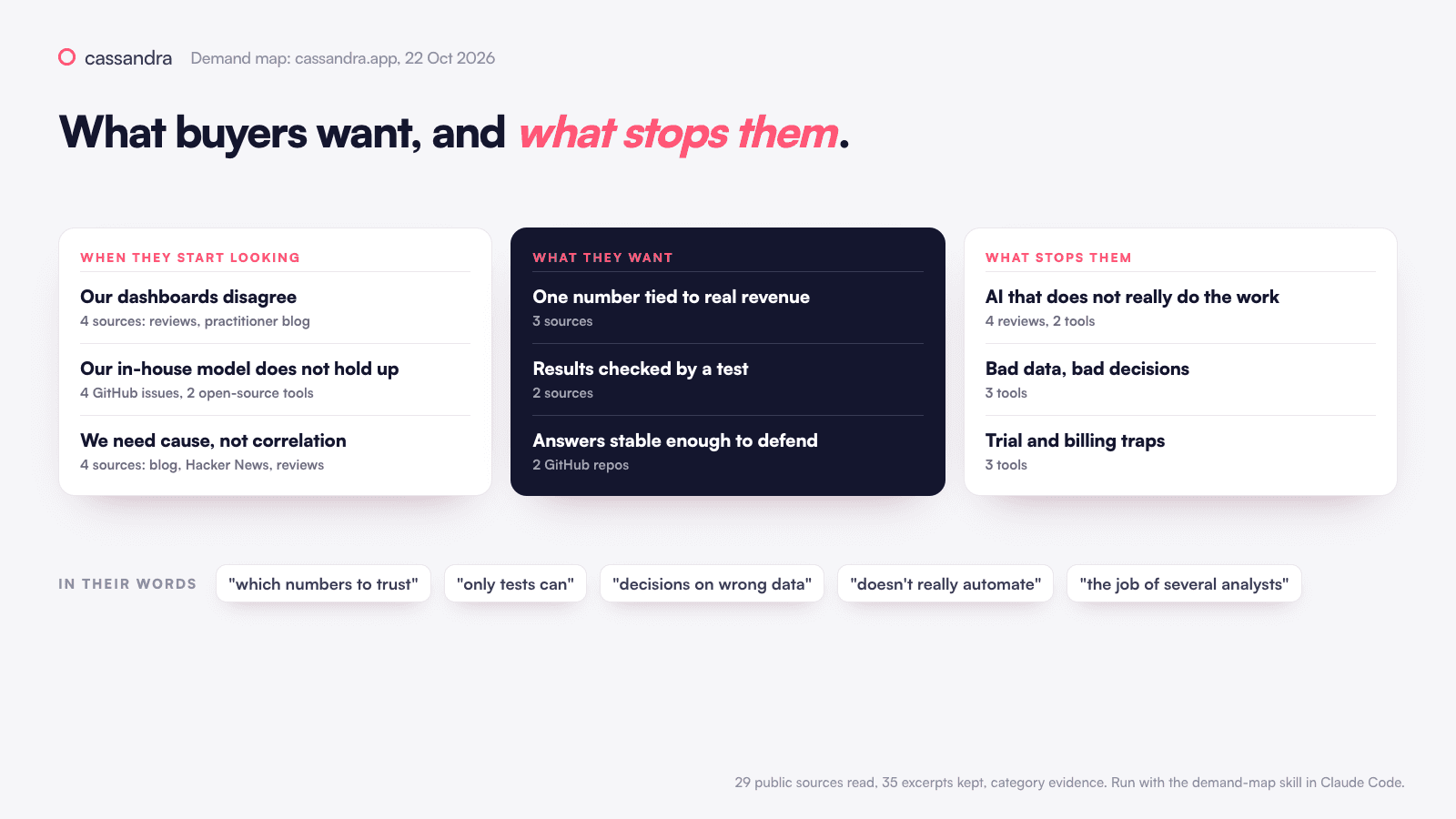
Some of the lines buyers wrote, all about the category rather than about us:
"half the time we weren't sure which numbers to trust" (review of an attribution tool, December 2025)
"it's not easy to communicate contradictory results to stakeholders" (GitHub issue on an open-source MMM)
"these models can't pinpoint causality, only tests can" (practitioner blog)
"Automation doesn't really automate, insights feel generic" (review of an AI ad tool, January 2026)
The positioning line it came up with: for growth teams who no longer know which numbers to trust, Cassandra gives one tested answer on what drives revenue, then does the follow-up work in the ad accounts within limits the team sets.
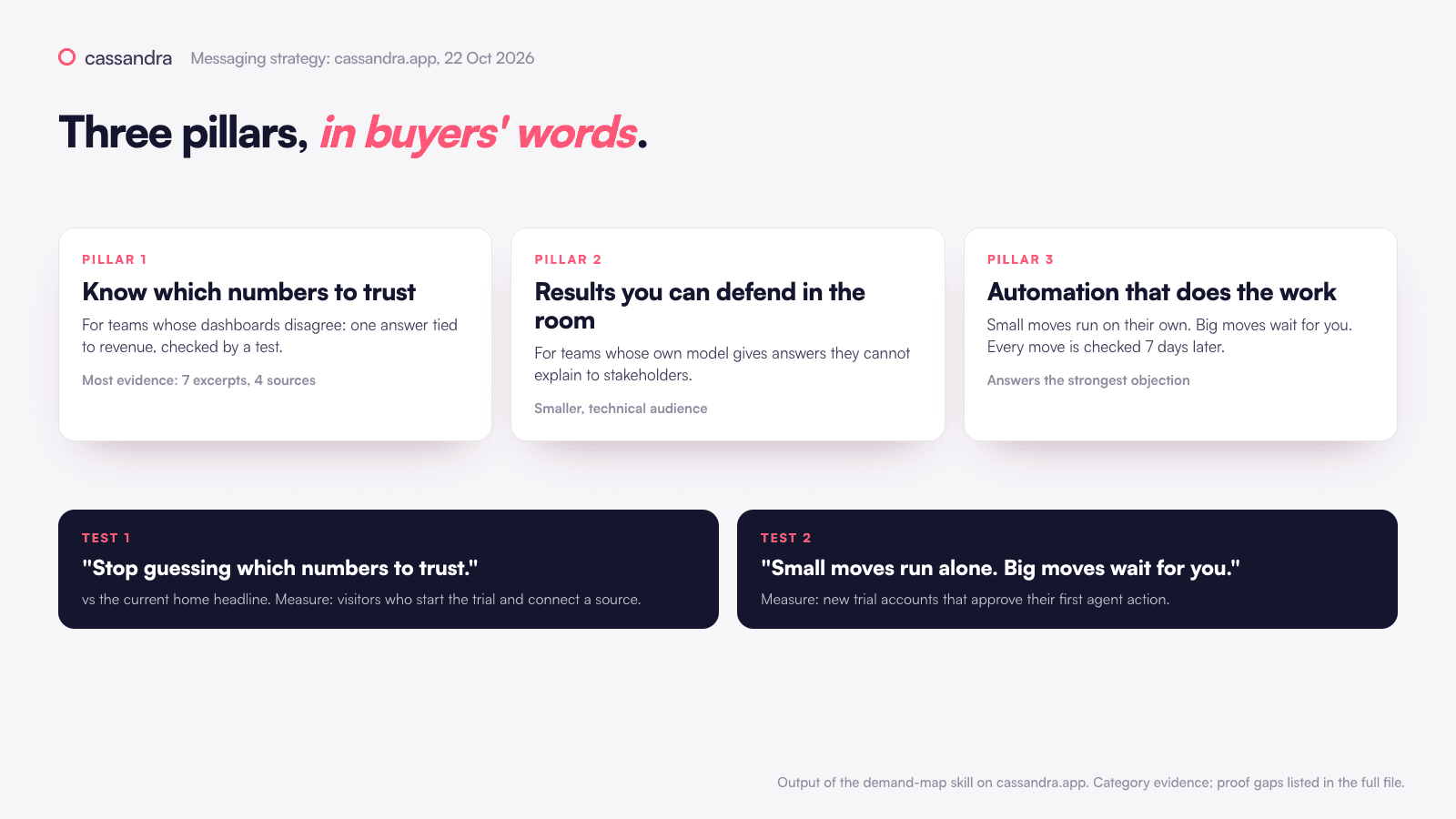
A few things surprised us. People don't start looking because they "want MMM". They start when their dashboards disagree and someone has to pick a number. The biggest objection wasn't price either, it was AI tools that promise to do the work and then don't. And every pillar came with a proof gap: something we say on the site but don't yet show publicly. Those are now on our to-do list.
If you sell to consumers and have Trustpilot or Amazon reviews, your map will quote people talking about your own brand, not only the category.
What if the skill finds no reviews or doesn't run?
What you see | Why | Fix |
|---|---|---|
| Wrong folder or name | Check the path is |
Few or no reviews found | Small or new brand | Add competitors: |
A review site gives an error (403) | It blocks automated reading | Normal. It shows up as "inaccessible" in the coverage table |
Quotes without links | Claude used search snippets | Ask it to keep only quotes from pages it actually opened |
The strategy sounds generic | Not enough evidence | Ask it to "also read threads about problems" |
How do you turn the messaging into results?
Until you test them, the pillars are educated guesses. Run the two first angles as separate ads with the same budget and audience, and judge them on sales rather than clicks (how to design a fair test). The map also gets a lot more useful next to your other data: which products people buy, what your ads already say, what your analytics shows and what earlier tests proved.
That's what we built Cassandra for. It runs this same demand map in its chat and combines it with your ad accounts, analytics, sales, products and incrementality tests, works out what to do next, and makes the changes in your ad accounts within the rules your team sets. You can start for free with your website and data.
Next
The skill file
Save this as ~/.claude/skills/demand-map/SKILL.md.