learn
/
methodology
Facebook ads not converting? Find the reason in your customers' words
Facebook or Meta ads not converting? Marketing AI skill to find the message problem your reviews, customers reveal. Free Claude skill inside.
Facebook or Meta ads not converting? Marketing AI skill to find the message problem your reviews, customers reveal. Free Claude skill inside.
By Gabriele Franco, co-founder of Cassandra


Get one practical idea every week to grow with the same team
A step-by-step guide to finding out why your Facebook and Meta ads don't convert, from what your customers already wrote. No survey needed.
If your Facebook ads aren't converting, check four things in this order: tracking, audience, landing page and the message. The first three show up in your dashboards. The message doesn't: your ad data tells you which angle lost, never why.
In this article
Why are my Facebook ads not converting?
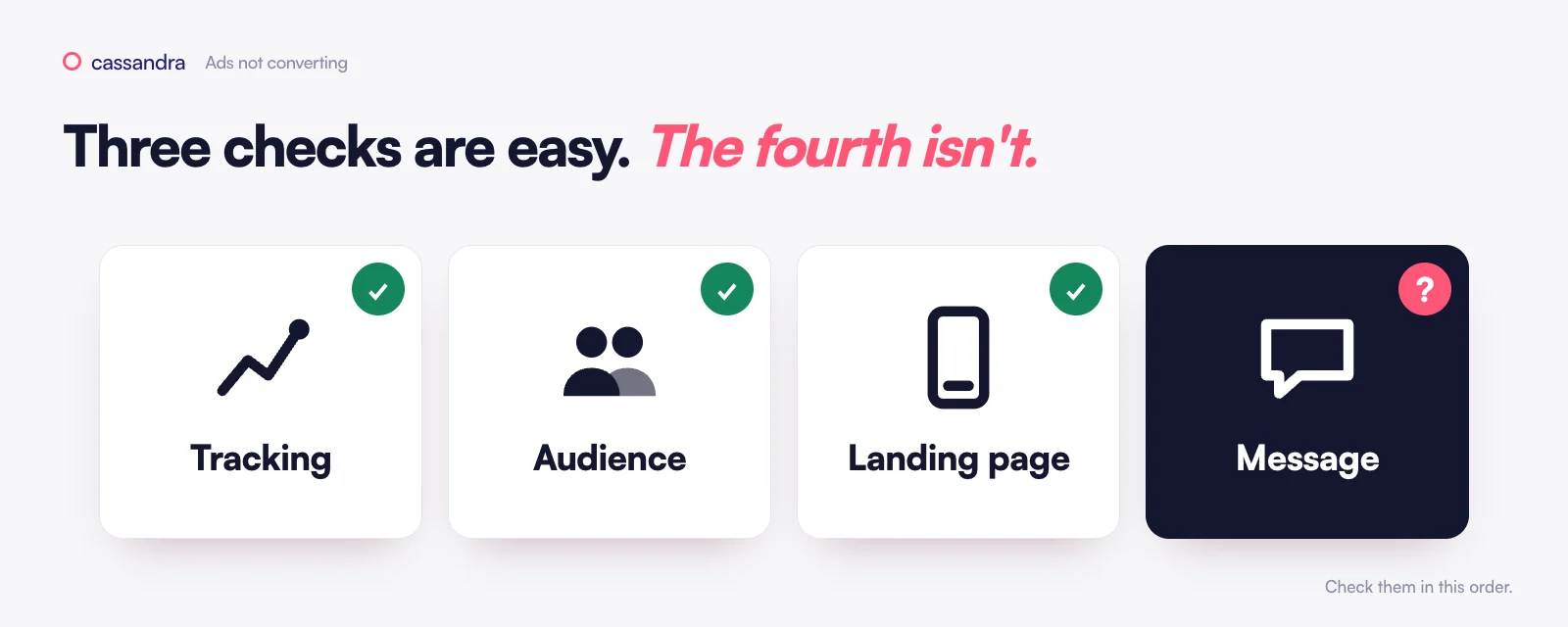
Check these in order. Each one rules out the next.
Tracking. Is the purchase event firing, and is it the event your campaign optimises for? If not, the ads may convert and you can't see it.
Audience. Are you reaching people who could buy? Compare your converting audiences with the ones that only click.
Landing page. Does the page keep the ad's promise, load fast on a phone, and make the next step obvious?
The message. Tracking, audience and page are fine, people click, and still don't buy. The ad is answering a worry your buyers don't have, and ignoring the one they do.
The first three have checklists. The fourth is where most teams guess:
Gut feeling. "Comparisons don't work for us." Maybe they just ran the wrong comparison.
A survey. Weeks to run, and people answer what they think you want to hear.
An AI asked to "describe our audience". You get your own opinion back in nicer words.
Your customers already told you, in public, in thousands of reviews and threads. In this article I'll show you how to turn them into the reason behind every winning and losing ad, and into your next brief.

Key findings at a glance
To show the method without exposing anyone's data, the two brands below are fictional and their numbers are simulated. The patterns are the kind this research finds.
You sell the tech, they buy no knee pain. A running shoe brand talks about its carbon plate and foam. Its customers talk about knees that stopped hurting.
The holiday ad answered the wrong worry. Backpack buyers worry the zips will fail. A gift shot doesn't show that. A demo does.
The biggest fear had no ads. Wrong size was the shoe brand's top complaint, and it got 2% of the spend.

Bottom line: the reason an ad doesn't convert is often written in your reviews. Nobody has lined it up against your ads.
Want to try it on your brand now? Get the free skill, or read on for the method.
How do reviews explain why ads don't convert?
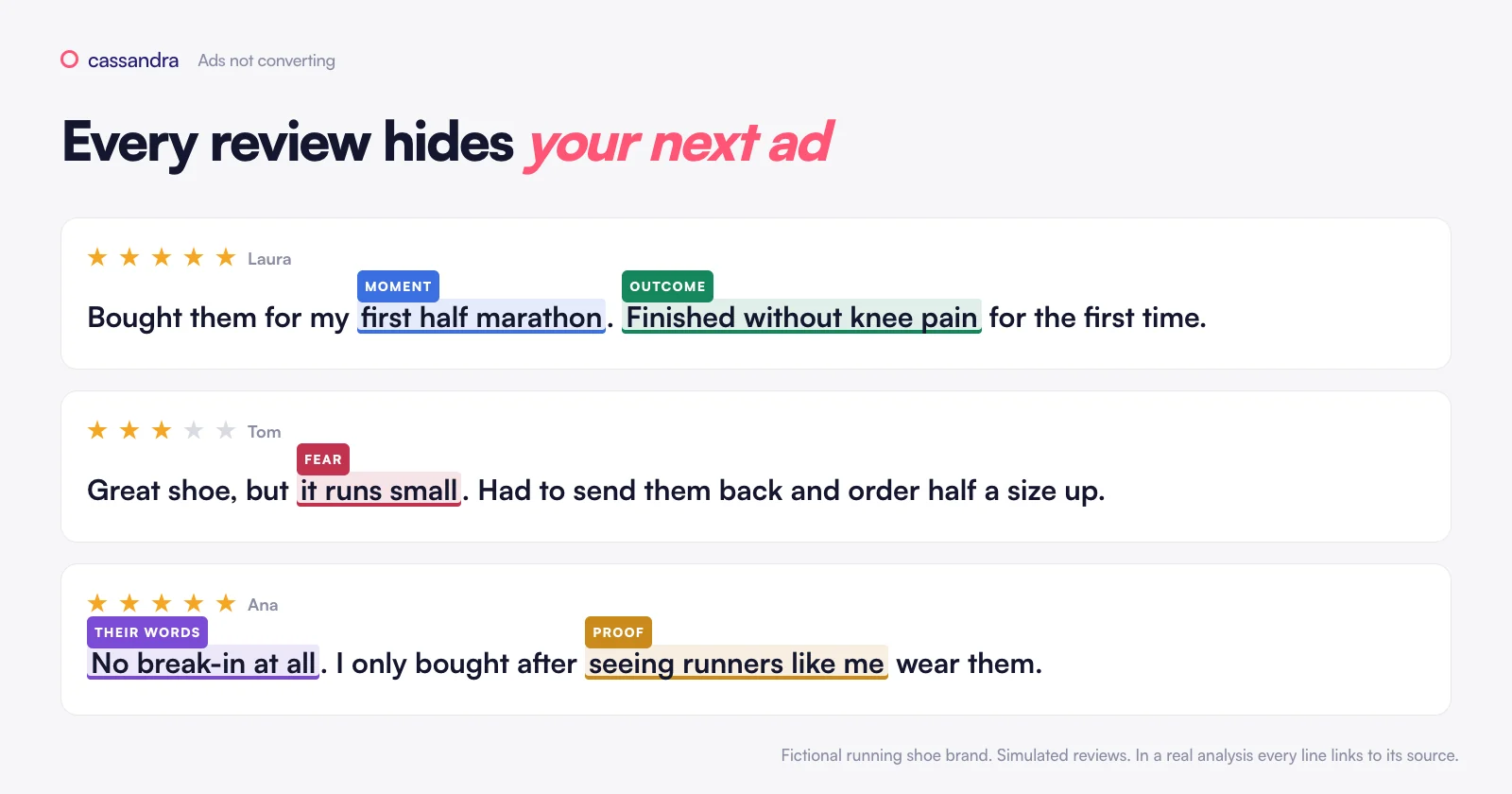
Turn what customers write into a customer map: a structured summary of what they want, fear and say, in six parts, each line backed by a quote and a link.
Think of your ad data as a thermometer and the customer map as the diagnosis. The thermometer tells you something is off. The diagnosis tells you what to do about it.
How do you find what customers want and fear, step by step?
Step 1: Read your own site
Note every promise you make (promises, not proof) and the fine print: offer dates, delivery times, exclusions. They become guardrails for every ad.
Step 2: Collect what customers write
Search your brand and your category:
"<brand>" review,"<brand>" reddit,"<brand>" vsbest <category> reddit,<category> worth it,<category> problem
The strongest objections often live in threads that never name you.
Step 3: Keep the originals and group them
Read the full page, not the snippet. Drop staff, affiliate and AI-written posts. Keep a short quote, the link and the date, then sort each one into the six parts.
Step 4: Test every reason against your ads
This is where customer research stops being research and starts explaining performance. Each reason is checked against your ads: confirmed, not confirmed, or never tested.
Here's the rule: a customer reason is a hypothesis until your ads confirm it.
What does it explain on an ad account?
Running shoe brand: every reason, tested

Four reasons, four decisions. The biggest one is the fear nobody tested: wrong size, the top complaint, with 2% of the spend.
Backpack brand: why the holiday ad didn't convert

The map also catches guardrails before any brief goes out: a competitor flaw that independent reviews don't support, or a "delivered by Christmas" promise the shipping policy can't back.
Common traps to avoid
The cherry-pick trap. Reading only five-star reviews. The fears live in the three-star ones.
The brand-words trap. Repeating your own promises back as "customer insight".
The snippet trap. Quoting a search summary instead of the page.
The no-results trap. Finding no reviews doesn't mean customers don't care. It means you didn't find them.
How long does this take by hand?
By hand you read hundreds of reviews, copy quotes, group them and match them to ads in a spreadsheet: days. In Cassandra the customer map runs as part of the ad creative analysis: every reason is tested against your ads and goes straight into the brief and the draft ad.
That's the loop to close: what works, why it works, the brief, the creative, the launch.
Is there a free Claude skill for customer research?
Yes. Our free kit includes it, for Claude and Claude Code.

Give it your website and it reads your site, reviews, forums and marketplaces, keeps only originals with their links, and builds the six-part map and a messaging strategy. With the ad analysis skill and your ad data, it tests each reason against your ads. Want only this skill? Follow the setup guide.
Where does customer research fit?
It's one source in a bigger picture. Reviews tell you what customers say, your ads what they did, your analytics and sales what happened after the click.
That's why we built Cassandra as a marketing brain: your ad accounts, analytics, sales, customer reviews and incrementality measurement in one place, reasoning together and suggesting what to do next. Start for free.
Key takeaways
When Facebook ads don't convert, rule out tracking, audience and the landing page first. If they hold, the problem is the message, and your customers already wrote down why. Map what they want and fear, test every reason against your ads, and brief only what holds.
So before your next brief, read the three-star reviews. The angle you're missing is usually in there.
The running shoe and backpack brands are fictional: their figures, ads and customer words are simulated to illustrate the method. Ad images are generated for this article.
A step-by-step guide to finding out why your Facebook and Meta ads don't convert, from what your customers already wrote. No survey needed.
If your Facebook ads aren't converting, check four things in this order: tracking, audience, landing page and the message. The first three show up in your dashboards. The message doesn't: your ad data tells you which angle lost, never why.
In this article
Why are my Facebook ads not converting?
Check these in order. Each one rules out the next.
Tracking. Is the purchase event firing, and is it the event your campaign optimises for? If not, the ads may convert and you can't see it.
Audience. Are you reaching people who could buy? Compare your converting audiences with the ones that only click.
Landing page. Does the page keep the ad's promise, load fast on a phone, and make the next step obvious?
The message. Tracking, audience and page are fine, people click, and still don't buy. The ad is answering a worry your buyers don't have, and ignoring the one they do.
The first three have checklists. The fourth is where most teams guess:
Gut feeling. "Comparisons don't work for us." Maybe they just ran the wrong comparison.
A survey. Weeks to run, and people answer what they think you want to hear.
An AI asked to "describe our audience". You get your own opinion back in nicer words.
Your customers already told you, in public, in thousands of reviews and threads. In this article I'll show you how to turn them into the reason behind every winning and losing ad, and into your next brief.
Key findings at a glance
To show the method without exposing anyone's data, the two brands below are fictional and their numbers are simulated. The patterns are the kind this research finds.
You sell the tech, they buy no knee pain. A running shoe brand talks about its carbon plate and foam. Its customers talk about knees that stopped hurting.
The holiday ad answered the wrong worry. Backpack buyers worry the zips will fail. A gift shot doesn't show that. A demo does.
The biggest fear had no ads. Wrong size was the shoe brand's top complaint, and it got 2% of the spend.
Bottom line: the reason an ad doesn't convert is often written in your reviews. Nobody has lined it up against your ads.
Want to try it on your brand now? Get the free skill, or read on for the method.
How do reviews explain why ads don't convert?
Turn what customers write into a customer map: a structured summary of what they want, fear and say, in six parts, each line backed by a quote and a link.
Think of your ad data as a thermometer and the customer map as the diagnosis. The thermometer tells you something is off. The diagnosis tells you what to do about it.
How do you find what customers want and fear, step by step?
Step 1: Read your own site
Note every promise you make (promises, not proof) and the fine print: offer dates, delivery times, exclusions. They become guardrails for every ad.
Step 2: Collect what customers write
Search your brand and your category:
"<brand>" review,"<brand>" reddit,"<brand>" vsbest <category> reddit,<category> worth it,<category> problem
The strongest objections often live in threads that never name you.
Step 3: Keep the originals and group them
Read the full page, not the snippet. Drop staff, affiliate and AI-written posts. Keep a short quote, the link and the date, then sort each one into the six parts.
Step 4: Test every reason against your ads
This is where customer research stops being research and starts explaining performance. Each reason is checked against your ads: confirmed, not confirmed, or never tested.
Here's the rule: a customer reason is a hypothesis until your ads confirm it.
What does it explain on an ad account?
Running shoe brand: every reason, tested
Four reasons, four decisions. The biggest one is the fear nobody tested: wrong size, the top complaint, with 2% of the spend.
Backpack brand: why the holiday ad didn't convert
The map also catches guardrails before any brief goes out: a competitor flaw that independent reviews don't support, or a "delivered by Christmas" promise the shipping policy can't back.
Common traps to avoid
The cherry-pick trap. Reading only five-star reviews. The fears live in the three-star ones.
The brand-words trap. Repeating your own promises back as "customer insight".
The snippet trap. Quoting a search summary instead of the page.
The no-results trap. Finding no reviews doesn't mean customers don't care. It means you didn't find them.
How long does this take by hand?
By hand you read hundreds of reviews, copy quotes, group them and match them to ads in a spreadsheet: days. In Cassandra the customer map runs as part of the ad creative analysis: every reason is tested against your ads and goes straight into the brief and the draft ad.
That's the loop to close: what works, why it works, the brief, the creative, the launch.
Is there a free Claude skill for customer research?
Yes. Our free kit includes it, for Claude and Claude Code.
Give it your website and it reads your site, reviews, forums and marketplaces, keeps only originals with their links, and builds the six-part map and a messaging strategy. With the ad analysis skill and your ad data, it tests each reason against your ads. Want only this skill? Follow the setup guide.
Where does customer research fit?
It's one source in a bigger picture. Reviews tell you what customers say, your ads what they did, your analytics and sales what happened after the click.
That's why we built Cassandra as a marketing brain: your ad accounts, analytics, sales, customer reviews and incrementality measurement in one place, reasoning together and suggesting what to do next. Start for free.
Key takeaways
When Facebook ads don't convert, rule out tracking, audience and the landing page first. If they hold, the problem is the message, and your customers already wrote down why. Map what they want and fear, test every reason against your ads, and brief only what holds.
So before your next brief, read the three-star reviews. The angle you're missing is usually in there.
The running shoe and backpack brands are fictional: their figures, ads and customer words are simulated to illustrate the method. Ad images are generated for this article.
Your marketing brain.
Cassandra is the AI marketing brain for growth teams. It learns what drives growth with marketing mix modeling and incrementality tests, then does the work in your ad accounts, within your rules.
Product
Company
Copyright © 2026 – All Rights Reserved
Your marketing brain.
Cassandra is the AI marketing brain for growth teams. It learns what drives growth with marketing mix modeling and incrementality tests, then does the work in your ad accounts, within your rules.
Product
Company
Copyright © 2026 – All Rights Reserved