
blog
/
insights
How to Plan your Marketing Mix For Q4
A step-by-step guide to optimizing your media mix for Q4—no expensive tool necessary.

Get a weekly dose of insightful people strategy content
How to Plan your Marketing Mix For Q4
A step-by-step guide to optimizing your media mix for Q4—no expensive tool necessary.
Here the video summary of this article:
Q4 is the highest-demand period of the year for most businesses. Getting your media mix right during this window can mean the difference between record-breaking performance and wasted budget. This guide walks you through exactly how to structure your Q4 media plan using principles from Marketing Mix Modeling (MMM).
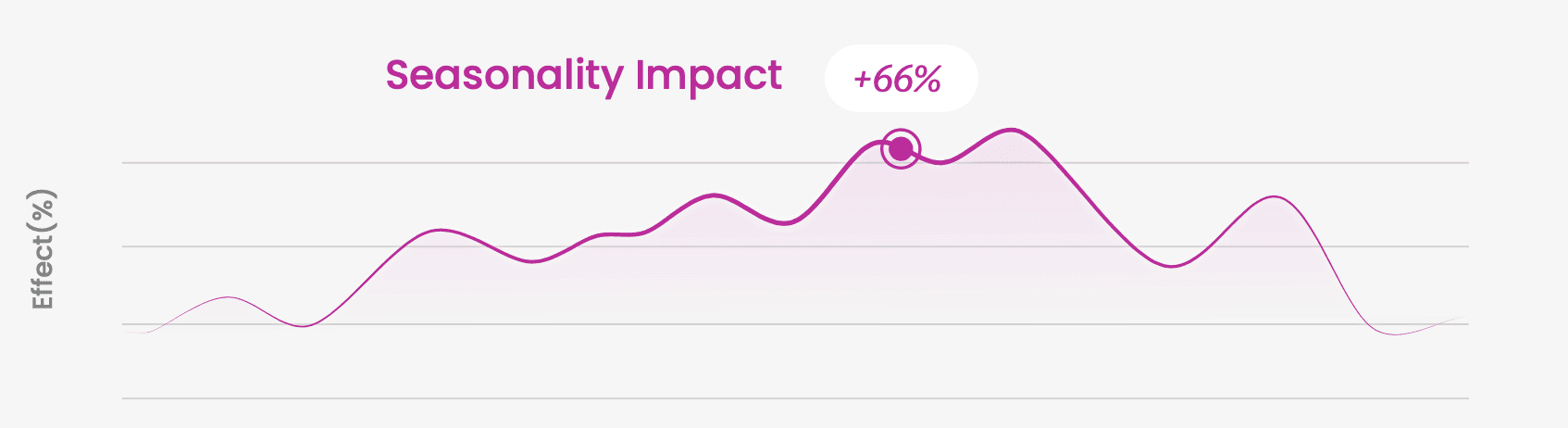
Seasonality: Budgeting based on changes in Demand over time
Every MMM solution—whether it's Robyn, Meridian, or your vendor's platform—estimates seasonality. Think of seasonality as the tide of demand. When it rises, conversions get easier. When it falls, conversions get harder.
You can leverage seasonality by:
Step 1: Use an MMM or Prophet
Use the model's seasonality component directly. This approach requires two to three years of weekly sales data (or qualified leads). Prophet will return a smooth seasonal pattern, and that pattern becomes your demand index by week.
Step 2: Turn Seasonality Into a Budget Plan
Once you have your seasonality curve, convert it into a weekly budget envelope. Your bottom-funnel spend should follow the tide of demand.
Here's the rule: If your model shows Cyber Week demand is twice the second week of October, your bottom-funnel budget for Cyber Week should be approximately twice your early-October baseline.
Account for the Delayed Impact of Your Ads
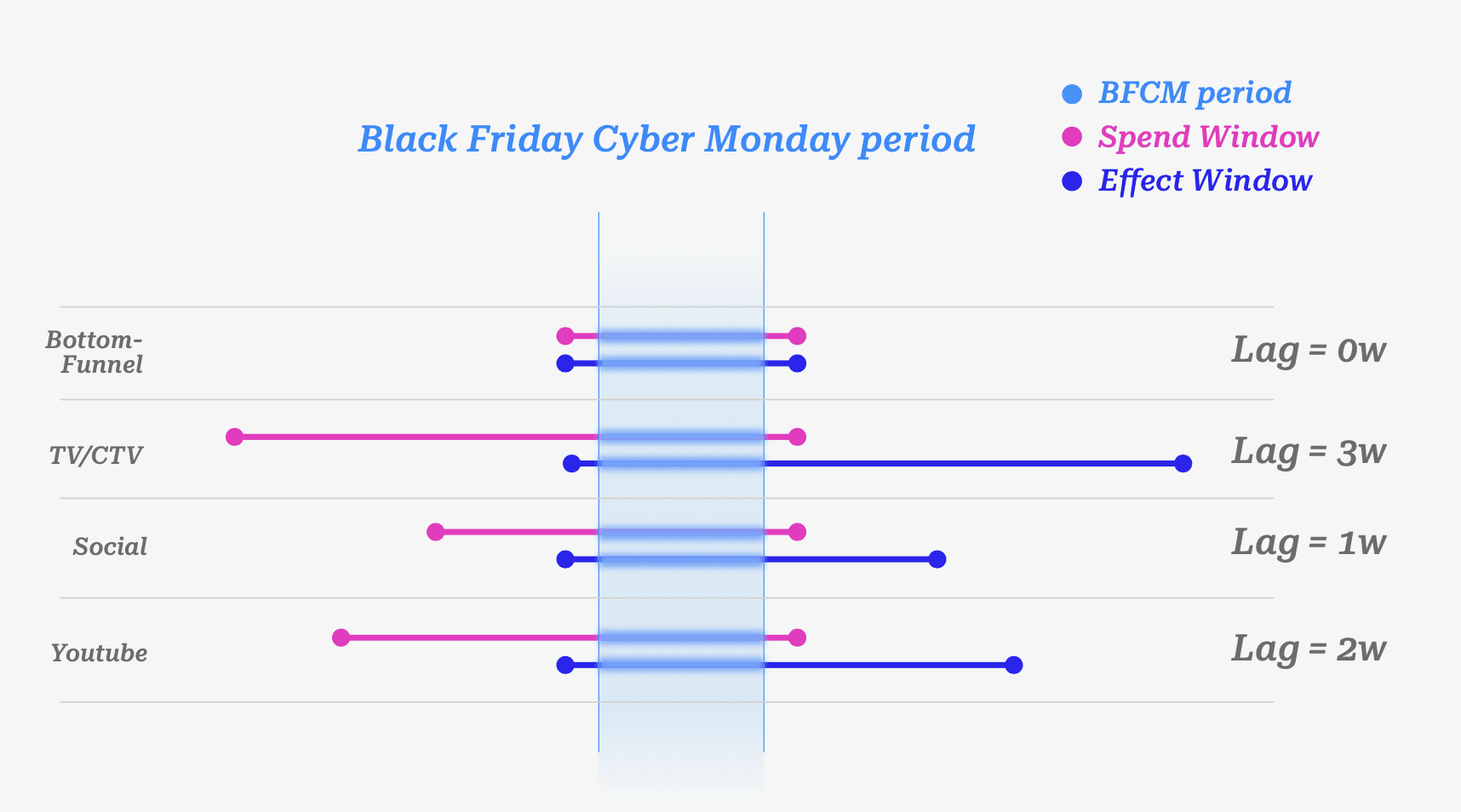
Not all channels deliver results on the same timeline. Prospecting social campaigns and video often take one to two weeks to convert into sales. TV and CTV typically take even longer.
Understanding two key concepts is essential:
Lag effect: The time between ad exposure and its first measurable impact on sales.
Carry-over effect: How ads continue to impact sales after the initial exposure. MMM platforms use the term "adstock" to combine both lag and carry-over effects.
How to Estimate Lag and Carry-Over Effects
While you can simulate adstock in Robyn or Meridian, the cleanest measurement comes from a geo incrementality test. Here's the four-step process:
Step 1: Split similar regions into Test and Control groups.
Step 2: Run a lift test by increasing spending in specific test regions. Compare the sales impact (lift) against business-as-usual regions.
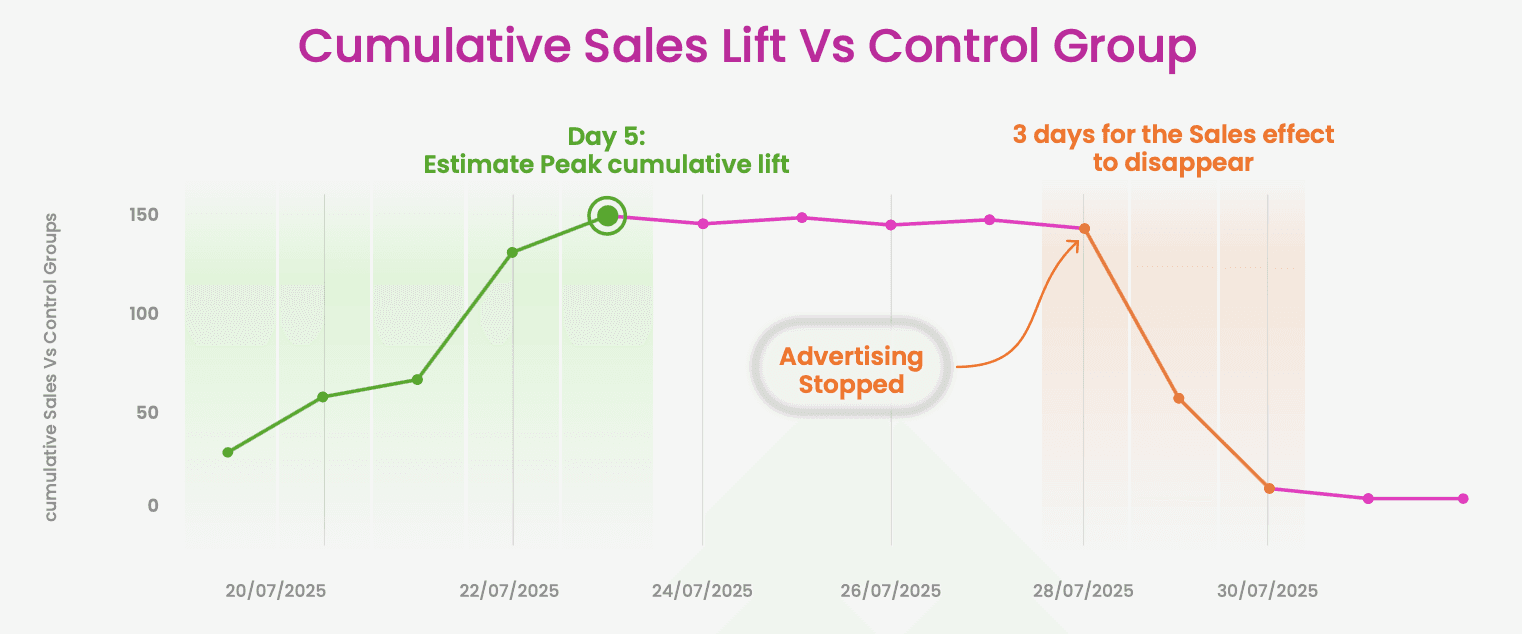
Step 3: Monitor cumulative lift in sales. When it peaks, you've found your lag effect estimate.
Step 4: Stop advertising in test regions after reaching peak effect. The time it takes for sales to return to control group levels is your carry-over effect.
In our Meta example, peak lift occurs around Day 5 after starting—that's the lag effect. After stopping ads, it takes approximately 3 days for sales to normalize—that's the carry-over effect.
Why Timing Matters for Media Planning
Your lag effect directly determines when to start campaigns. If Meta peaks 5 days after launch and your demand peak is Black Friday, your video campaigns need to start at least 5-6 days before Black Friday (adding one extra day as a safety buffer).
Apply this principle to each channel so their peak effect aligns with your peak demand.
Put Timing and Seasonality Together
At this point, you have two critical inputs:
1. A weekly demand curve
from your seasonality analysis. This determines your bottom-funnel budget.
2. A start plan per channel
based on lag effect estimates. This determines your upper-funnel budget.
This gives you a total budget per week and clarity on which channels should already be running before peak weeks. The strategy is simple: prospecting warms the audience, bottom-funnel catches them when intent is high. Seed, then harvest.
Typical Lag Times by Channel
Bottom-Funnel (Search, Retargeting): 0 weeks lag—immediate impact
Social (Meta, TikTok): 1 week lag
YouTube: 2 weeks lag
TV/CTV: 3 weeks lag
Leverage a Budget Allocator for Optimal Distribution
Budget allocators from open-source solutions like Meridian, Robyn, and PyMC-Marketing are built to split a single budget across channels based on response curves. However, they don't schedule that budget over time—that's by design.
The Two-Step Process
Step 1: Determine your overall budget.
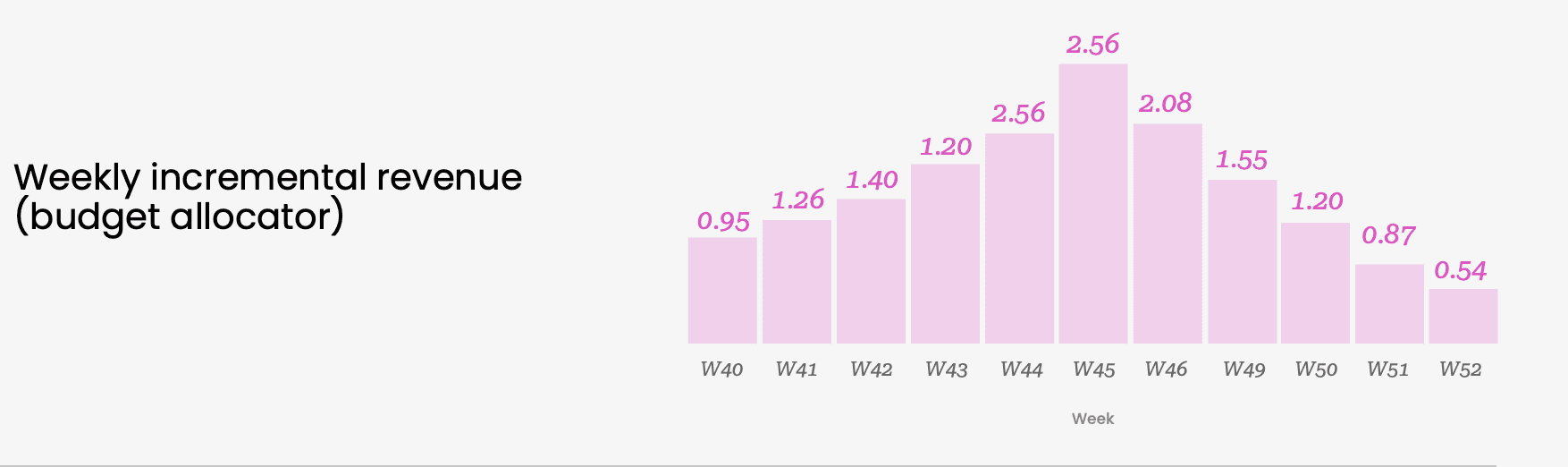
If you have a statistically robust and business-validated MMM, this is a quick process. You'll end up with a weekly envelope for Week 46, Week 47, Cyber Week, and so on.
Step 2: Allocate each week's budget.
Feed each week's envelope into the allocator. It will distribute money across channels based on marginal return (the next dollar's expected iROAS), each channel's saturation levels, your caps, and ramp limits.
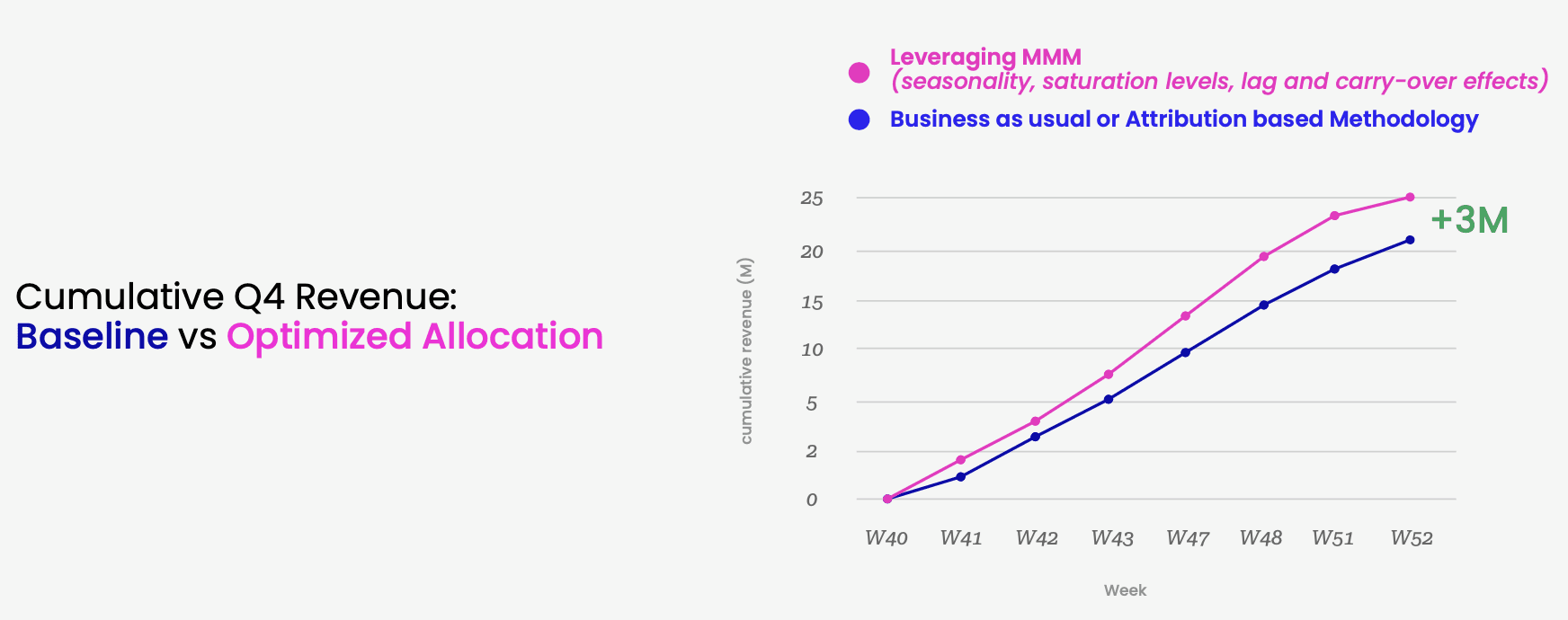
Run this week by week. The allocator outputs predicted revenue increase for each week. Sum those weekly predictions across Q4 to calculate your total expected uplift.
Think of it as an auction for the next dollar. Each channel bids its marginal return over time. The highest bid gets the dollar until its return drops, then the next channel wins.
Common Traps to Avoid
Using last-click attribution for budget decisions overweights bottom-funnel and starves upper-funnel channels of the investment they need.
Starting top-funnel too late means lag pushes your impact after the peak week. You miss the party entirely.
Skipping ramp limits causes platforms to wobble with learning resets and noisy performance data.
Ignoring shipping and fulfillment cutoffs wastes budget driving demand you can't actually fulfill.
Best Practices for Q4 Success
Keep simple guardrails in place.
Set maximum spend per channel and week-over-week ramp limits to stabilize delivery and keep your data clean.
Set weekly profit versus revenue goals.
Hold to your target for each week to keep decisions consistent and avoid reactive budget shifts.
Align your entire team.
Make sure creative, media, and operations are all working from the same timeline and understand the lag effects at play.
Key Takeaways
Beating last year's Q4 ROI comes down to three fundamentals: understanding your seasonality curve, accounting for channel-specific lag effects, and using marginal return to allocate budget week by week.
The brands that win Q4 aren't necessarily spending more—they're spending smarter by timing their upper-funnel investments to peak exactly when demand is highest.
